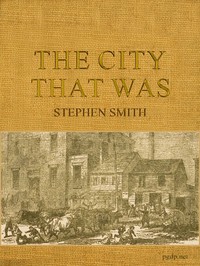
Stephen Smith, a former commissioner of the Metropolitan Board of Health, opens The City That Was with a dedication to Dorman Bridgman Eaton, signaling the book's dual focus on a specific reformer and a broader sanitary revolution. The publisher's note immediately establishes the work as a contemporaneous document: Smith's 1864 medical inspection report, delivered to a legislative committee, is reproduced as evidence of New York's conditions. This framing invites readers to treat the text not as a memoir but as a primary source, one that claims to document a city transformed by public health measures.
A Physician's Evidence, Not a Historian's Retrospect
The publisher's note insists that Smith's account is not a historian's exaggeration but a physician's report. It describes the chapter on New York in 1864 as a contemporaneous document, based on a systematic medical inspection. This distinction matters: Smith writes as a witness and investigator, not a memoirist. Readers should approach the statistical tables and ward-by-ward descriptions as evidence gathered under specific legislative authority, not as general impressions. The note's language—'the appalling chapter'—prepares us for data that may seem implausible, but it anchors credibility in Smith's role as a trained expert and commissioner.
Mortality Rates as a Rhetorical Weapon
Smith deploys comparative mortality statistics to challenge official complacency. He cites London's average death rate of 22 per 1,000 and Philadelphia's 20, while New York's average stood at 33 per 1,000 for 1850–1860. He quotes Dr. Jewell of Philadelphia delivering a 'withering rebuke' to New York's City Inspector, who had claimed the city was among the healthiest. Smith then calculates that if New York matched Philadelphia's rate, it would have saved 10,577 lives in 1860 alone. These numbers are not dry figures; they are accusations. The text uses them to argue that preventable deaths—77,000 over a decade—were a moral and administrative failure.
The Unequal Distribution of Filth and Disease
Smith insists that the excess mortality and sickness fall 'exclusively upon the poor and helpless.' He estimates that half of New York's population had a death rate no higher than a healthy country town, while the other half suffered 'frightfully severe' pressure. This spatial inequality is central to his argument: sanitary reform is not a universal benefit but a targeted intervention for the neglected. The excerpts do not detail specific neighborhoods, but the implication is clear—wealthy wards like the Seventeenth Ward escaped the worst. Smith's language—'demon of filth,' 'immured in filth'—frames the issue as a moral crisis demanding action.
Constant Sickness as a Hidden Toll
Beyond mortality, Smith emphasizes the burden of sickness. He cites an estimate of 28 cases of sickness for every death, and reports that among families living in filth, the constant sickness rate could reach 50, 60, or 70 percent. This moves the argument from death counts to daily suffering. The phrase 'constant sickness authority' suggests he is drawing on established epidemiological reasoning, but the specific census data he mentions is not reproduced in the excerpts. Readers must take his word for the accuracy of these group surveys, which he presents as firsthand evidence of conditions among the poor.
Smith's book is best read as a reformer's brief, not a neutral history. The excerpts show him marshaling statistics, official reports, and his own inspections to build a case for sanitary legislation. Readers should note how he positions himself as an expert witness, using comparative data to shame local officials. The dedication to Eaton and the publisher's framing suggest the book aims to memorialize a specific reform movement. Approach the text with attention to its rhetorical strategies—the numbers, the rebukes, the moral language—rather than expecting a comprehensive narrative of New York's transformation.
Reading about those 1860s tenement wards, I remembered walking through my grandmother's neighborhood decades ago, the same tired brick, the same unspoken sickness in hallways. That feeling returned while turning through The Cholera: the claims of the poor upon the rich — Background and Themes—not statistics, but the quiet weight of who gets ignored, and how little has softened since.