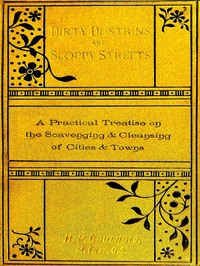
Boulnois opens his treatise with a direct claim: no book or pamphlet has yet been written on this subject. The preface frames the work as a practical aid for surveyors and a means to educate householders, who often 'inadvertently or purposely retarding the execution of some very necessary though unostentatious sanitary measures.' The tone is that of a professional addressing peers, yet the author also hopes to interest general readers. The table of contents immediately signals a systematic approach: thirteen heads under scavenging, legal references to the Public Health Act 1875, and detailed chapters on house refuse, dustbins, and collection methods. Boulnois writes as both engineer and advocate, blending technical specifics with a clear moral purpose.
The Dustbin as a Technical Problem
The third chapter, devoted entirely to the dustbin, reveals Boulnois's engineering mindset. He critiques the fixed ashpit recommended by the Public Health Act, proposing instead movable dust boxes. His reasoning is practical: fixed pits encourage accumulation and foul smells, while movable containers allow regular removal. The author draws on model bye-laws and six clauses on ashpits, but his own suggestions go further, advocating for burning some waste products. This section shows how a seemingly mundane object—the household dustbin—becomes a site of legal, sanitary, and design debate. Boulnois's language is precise: he speaks of 'objections' and 'suggestions for improvements,' never losing sight of the householder's daily experience. The dustbin, in his view, is not a passive receptacle but a critical node in the urban waste system.
Street Sweeping and Pavement Economics
In the later excerpts, Boulnois turns to the streets themselves, comparing granite setts, macadam, and asphalt. He cites a report on impervious pavements, noting that after frost and snowfall, ordinary jointed roadways become loose, allowing mud to ooze up. The economic calculus is explicit: macadam sweepings are valueless as manure, being composed of silicate, and their disposal is a 'difficult matter.' Boulnois enumerates options—mixing with house refuse, washing for mortar, filling quarries, or dumping at sea—each weighed by cost and feasibility. The Parisian comparison adds scale: 13,000,000 square yards cleansed between three and six a.m., employing 2,200 men, 950 women, and 30 boys, plus mechanical sweepers. Boulnois notes that Paris mud has lost manurial strength, reducing municipal receipts, and he advocates for disinfectants, a practice he believes British authorities should adopt.
The Human Element in Sanitary Work
Boulnois does not shy from social commentary. In discussing collection methods, he refers to the 'dirty habits of the lower classes' and the need for house-to-house visitation. The bell or signal system, he argues, leads to temporary receptacles that make streets filthy. His language is blunt, reflecting Victorian class assumptions, but his focus remains on practical outcomes. The Parisian workforce data—2,200 men, 950 women, 30 boys—hints at the human scale of sanitation. Boulnois's own role as City Surveyor of Exeter grounds his observations in daily administration. He writes from experience, not theory, and his recommendations are shaped by what he has seen fail or succeed. The reader encounters a professional who must balance cost, public cooperation, and the stubborn realities of mud, frost, and human behavior.
Evidence from Structure and Voice
The treatise's structure mirrors its subject: methodical, categorized, and cumulative. Boulnois divides scavenging into thirteen heads, devotes chapters to legal definitions, and includes statistics on trade versus house refuse. His voice is authoritative but not pedantic; he uses first-person plural ('we') and direct address ('the householder'). The excerpts show a writer who values clarity over flourish. He quotes reports and cites engineers, but his own conclusions are stated plainly. The Paris section, for instance, ends with a pointed observation: disinfectants are 'largely used' there, a practice 'which might be followed with advantage' in Britain. Boulnois's evidence is always tied to action—what works, what costs, what can be improved. This pragmatic voice, grounded in municipal reality, gives the treatise its enduring interest as a document of Victorian urban management.
Boulnois's treatise rewards a reading that attends to its technical details and social assumptions alike. The excerpts offer a window into the daily challenges of nineteenth-century sanitation: the composition of mud, the economics of manure, the design of dustbins. Readers interested in urban history, public health, or the evolution of municipal engineering will find here a primary source that is both specific and suggestive. The author's voice—confident, practical, occasionally judgmental—anchors the work in its time, while the problems he addresses remain recognizably modern.
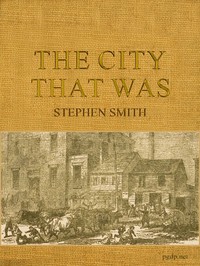
Fingering the yellowed pages of that 1881 treatise, I kept circling back to the dustman’s quiet, thankless rhythm, the city breathing through his daily rounds. It felt like stumbling onto a forgotten conversation about what a place keeps and discards. That same unspoken ache surfaced later in The City That Was — Context and Discussion, where absence lingers between the lines. Funny how a broom and a memory can sweep the same corner.