About 695 minutes
Hygiene: a manual of personal and public health (New Edition) — Themes and Context
Public Health
159,822 recorded words. 13 minutes difference from this book's estimate.
View Gutenberg source #58591
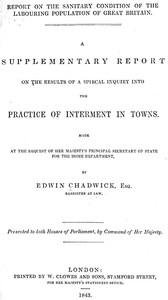
Before opening A supplementary report on the results of a special inquiry into the practice of interment in towns. — Text and Context, the edition data offers a quick orientation: 156,813 words, 11 hr 22 min estimated reading time, and 21 detected text sections.
The text analysis averages about 28.5 words per sentence, while the detected sections provide another way to judge how the source is divided.
Project Gutenberg metadata also associates the work with “Working class -- Great Britain,” connecting these edition facts with the source record’s subject description.
Explore this collection
These alternatives are selected using recorded categories and estimated reading time.
About 695 minutes
Public Health
159,822 recorded words. 13 minutes difference from this book's estimate.
View Gutenberg source #58591About 473 minutes
Public Health
108,600 recorded words. 209 minutes difference from this book's estimate.
View Gutenberg source #21353About 280 minutes
Public Health
64,378 recorded words. 402 minutes difference from this book's estimate.
View Gutenberg source #69823Search stored excerpts and compare books → Choose by your preferences →
Choices use stored catalog measurements. Estimates vary with reading speed. A shared category is a catalog label, not a claim that two books have the same argument or literary quality.
Search reads excerpt text stored with this catalog and links to its associated Gutenberg record. The connection is stored in the site database; this tool does not recheck that every excerpt is word-for-word identical to that external record. Excerpt search does not cover every chapter and does not verify historical publication dates.
Catalog snapshot checked: 2026-09-25. Coverage: 93 public books, 93 available source excerpts.
Read the complete public-domain text at its original source.
Read on Project GutenbergEdwin Chadwick's 1843 supplementary report on town interment is a document of administrative advocacy, built from witness testimony, statistical tables, and historical precedent. Its language oscillates between the measured cadence of a parliamentary paper and the urgent, sometimes graphic, accounts of medical officers and clergymen. Chadwick's own prose tends toward the declarative—'the greatest proportion of deaths occur in the single rooms in which families live and sleep'—while the quoted evidence introduces vernacular detail: bodies kept in living spaces, wells tainted by seepage, and the 'moral evils' of delayed burial. This interplay of official voice and raw observation gives the report its persuasive force.
Chadwick organizes his argument through numbered sections and marginal summaries, a format that mirrors the bureaucratic genre of the parliamentary command paper. Each section typically opens with a proposition—'Grounds of exception to the admitted necessities of the abolition of intra-mural interment examined'—then proceeds to marshal evidence from named correspondents. The headings themselves function as miniature arguments: 'Positive evidence of the propagation of acute disease from putrid emanations' leaves little doubt about the conclusion. Within this framework, Chadwick frequently shifts from general statement to specific instance, as when he moves from the claim that 'the greatest proportion of deaths occur in the single rooms' to a series of localized reports from the western and eastern districts of the metropolis and from Leeds. This alternation between abstract and concrete gives the report a cumulative, almost forensic rhythm.
The report's narrative voice is not unitary. Chadwick the barrister frames the inquiry, but the body of the text is crowded with other speakers: medical officers, clergymen, and even a reference to a plan for suburban cemeteries that includes a quotation about 'beautiful monuments' and 'a graceful border' of fields around the city. These quoted passages often carry a different tone—more descriptive, more morally charged. One clergyman's evidence contrasts the 'real good air and walks for the living' with the current state of town churchyards, where bodies are 'piled four or five upon one another.' Chadwick also reaches back to historical authority, citing the practices of Jews, early Christians, and the Emperor Constantine to argue that burial inside churches was a later corruption. The effect is a layering of voices—administrative, medical, clerical, historical—that together build a case no single speaker could sustain alone.
The report's pace is deliberate, even repetitive. Chadwick does not rush to his conclusion; he builds it section by section, often revisiting the same point from different angles. For instance, the question of whether emanations from human remains are 'innocuous' is examined first through negative evidence, then through incomplete statements of fact, then through positive instances of disease propagation. This methodical accumulation mirrors the legal standard of proof Chadwick, as a barrister, would have known. Yet within this steady progression, there are sudden accelerations—moments where the language tightens into a stark image: 'the dead need not be disturbed at the pleasure of the sexton, or piled four or five upon one another, or bones thrown out to gain room.' Such passages break the administrative calm, reminding the reader that the subject is not merely policy but the physical reality of decay and overcrowding.
Readers approaching this report should attend to its dual nature: it is both a piece of Victorian social reform literature and a carefully constructed legal argument. Chadwick's method—collecting testimony, organizing it under thematic headings, and letting the witnesses speak—anticipates the modern public inquiry. The report rewards those who read slowly, following the chain of evidence from general principle to local instance, and who listen for the different voices that Chadwick weaves into his case.
That rainy afternoon, Chadwick’s inquiry sat open beside me, his witness accounts of damp churchyards and miasmatic air settling into my mood like the grey light outside. I kept thinking how the same careful, humane attention could turn toward prevention rather than repair. Later, half-idly, I opened the other volume on the shelf, Public health and insurance: American addresses — Text and Context, and found that quieter, later echo of his reach.
Build a private reading journal entry for this title.