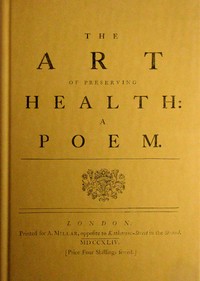
John Armstrong's The Art of Preserving Health (1744) is a didactic poem in four books—Air, Diet, Exercise, and the Passions—that instructs readers in hygienic living through blank verse. Rather than a dry medical treatise, Armstrong invokes Hygeia, goddess of health, and adopts the persona of a poet-physician who ventures 'thro' paths the muses never trod before.' The work balances classical allusion with practical observation, as when he warns against exercising 'from the recent meal' or recommends cold bathing for those traveling from frozen climes to torrid zones. Armstrong's diction shifts between elevated apostrophe and blunt counsel, creating a distinctive voice that is both authoritative and intimate.
The Poet as Physician
Armstrong frames his medical advice within a poetic tradition, opening with an invocation to Hygeia that echoes epic conventions. He acknowledges the difficulty of conveying 'dry philosophic precepts' in 'clear and animated song,' yet proceeds with confidence. The poem is dedicated to Dr. Richard Mead, a prominent physician, whom Armstrong calls 'belov'd by all the graceful arts.' This dedication signals Armstrong's ambition to merge medicine with literature. Throughout, he uses direct address—'you,' 'your'—to engage the reader as a patient or pupil. The voice is that of a knowledgeable guide who has 'traced the secret wilds of nature' and now shares his findings. Armstrong's self-awareness as a poet-physician is evident when he admits his work is 'a well-design'd essay, Howe'er imperfect,' modestly positioning his poem as a contribution to public health knowledge.
Diction of the Body and Environment
Armstrong's word choices create a tangible sense of bodily processes and environmental effects. He describes the blood 'maddens in the veins' under the 'burning Lion' of summer, and speaks of the 'unctuous phlegm' that 'much toil demands.' His language is sensory: the 'damp waste forest, motionless and rank' that 'smothers earth,' or the 'chilling dews' that invite 'the cold embrace of humid skies.' Such phrases ground abstract advice in physical experience. He also employs personification, as when 'the cordial powers claim all the wandering spirits to a work of strong and subtle toil' after a meal. This diction reflects the humoral theory of the era, where health depended on balance of qualities like hot, cold, moist, and dry. Armstrong's vocabulary is precise yet evocative, making the reader feel the 'slow diseases of the torpid year' as tangible threats.
Structure and Argumentative Rhythm
The poem's structure mirrors its didactic purpose: each book addresses a specific aspect of health, with arguments built through contrast and example. In the excerpt from Book I, Armstrong contrasts the 'chearful guardian' Hygeia with the 'wasteful host of pain and sickness, squallid and deform'd.' He then lists the sources of disease—'meagre famine,' 'putrid watry element,' 'vile carnage of th' inhuman field'—before asserting Hygeia's power to 'avert the general bane.' This pattern of problem-solution recurs throughout. In the later passage on exercise, he advises different regimens for 'leaner habits' versus those 'too corpulent,' and distinguishes between seasons: winter allows 'no labours too hard,' while summer demands restraint. Such nuanced advice shows Armstrong's rhetorical skill in adapting general principles to individual circumstances, creating a rhythm of precept and qualification that keeps the reader engaged.
Social and Moral Undertones
Armstrong's health advice is intertwined with social commentary and moral judgment. Cleanliness, he asserts, 'adorns the rich; The want of this is poverty's worst woe,' linking hygiene to class and decency. He also warns against making 'the kindest regimen Essential to his health,' lest one become unfit for 'human kind, nor art nor trade pursue.' This suggests that excessive health obsession can be antisocial. His remarks on marriage—'married sires, as well as lovers, still pretend to taste'—and the 'skilful virgin' who knows the value of purity reveal a gendered perspective. The poem's moral dimension is most explicit in the final book on the Passions, but even in earlier sections, Armstrong implies that health is a duty, and that vice and 'heedless pleasure' bring disease. These undertones reflect Enlightenment ideals of self-discipline and social responsibility, making the poem not just a medical guide but a conduct manual.
Readers approaching The Art of Preserving Health should attend to how Armstrong weaves classical form with empirical observation. His poem rewards attention to its verbal texture—the way he makes abstract advice concrete through vivid imagery and direct address. While the medical theories are outdated, the poem offers insight into 18th-century attitudes toward the body, nature, and self-care. It stands as a unique fusion of poetry and preventive medicine, best enjoyed as a historical document of literary and scientific ambition.
Armstrong’s poem whispers that the body’s care is a quiet, daily art—a vigilance of breath and bread. I find that same unhurried wisdom echoed, a hundred years later, within the practical pages of Health on the Farm: A Manual of Rural Sanitation and Hygiene — Text and Context, as if both authors understood that health is simply the old, faithful habit of tending one’s own patch of earth.