About 237 minutes
The House We Live In; or, The Making of the Body — Context and Discussion
Medicine
54,436 recorded words. 4 minutes difference from this book's estimate.
View Gutenberg source #65968
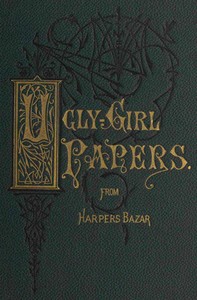
Before opening The ugly-girl papers — Reading Companion, the edition data offers a quick orientation: 53,394 words, 3 hr 53 min estimated reading time, and 31 detected text sections.
The text analysis averages about 18.9 words per sentence, while the detected sections provide another way to judge how the source is divided.
Project Gutenberg metadata also associates the work with “Women -- Health and hygiene,” connecting these edition facts with the source record’s subject description.
Explore this collection
These alternatives are selected using recorded categories and estimated reading time.
About 237 minutes
Medicine
54,436 recorded words. 4 minutes difference from this book's estimate.
View Gutenberg source #65968About 227 minutes
Medicine
52,197 recorded words. 6 minutes difference from this book's estimate.
View Gutenberg source #46711About 214 minutes
Medicine
49,137 recorded words. 19 minutes difference from this book's estimate.
View Gutenberg source #24886Search stored excerpts and compare books → Choose by your preferences →
Choices use stored catalog measurements. Estimates vary with reading speed. A shared category is a catalog label, not a claim that two books have the same argument or literary quality.
Search reads excerpt text stored with this catalog and links to its associated Gutenberg record. The connection is stored in the site database; this tool does not recheck that every excerpt is word-for-word identical to that external record. Excerpt search does not cover every chapter and does not verify historical publication dates.
Catalog snapshot checked: 2026-09-25. Coverage: 93 public books, 93 available source excerpts.
Read the complete public-domain text at its original source.
Read on Project GutenbergS. D. Power’s The Ugly-Girl Papers (1874) opens with a preface that frames the toilet as a delicate science, akin to medicine, and acknowledges the limits of any single recipe. The author’s voice is direct and practical, drawing on historical recipes—such as Madame Vestris’s egg-and-alum paste for firming skin or the milk of roses from Charles II’s era—while warning against dangerous practices like the quicksilver used by ladies of George I’s court. Power balances historical curiosity with a physician’s caution, advising readers to consult doctors and noting that no prescription suits all cases.
The text is dense with specific formulas, each attributed to a named source or era. Power reproduces Lola Montez’s ointment for supple limbs, Boerhaave’s Esprit Odontalgique for toothache, and gray pastilles for breath purification. These are not mere curiosities; they are presented as usable, with precise measurements and instructions. The author’s tone is matter-of-fact, treating the reader as a competent practitioner. For instance, the toothache remedy—camphor, opium, oil of cloves in alcohol—is offered without embellishment, only the note that even beauties suffer after a snowy night. This reliance on named authorities (Boerhaave, Madame Celnart) gives the book a scholarly veneer, even as it addresses everyday concerns like chapped skin or stained teeth.
Power’s advice extends beyond cosmetics to regimen: bathing, anointing, and diet. She recommends oiling joints daily after the bath, citing Oriental practice, and notes that opera dancers use deer-fat ointment to relieve stiffness. The body is treated as a machine requiring regular lubrication and cleansing. The author is attentive to detail—shoe linings, stockings, the quality of soaps—and insists on nicety in all things. Her language is clinical: “The muscles of the back feel a sensible relief from this treatment, especially when strained with work or with carrying children.” This blend of domestic practicality and anatomical awareness gives the book a distinctive voice, neither purely medical nor purely cosmetic.
Despite her enthusiasm for historical recipes, Power repeatedly warns against harmful practices. She condemns the use of quicksilver and enamel-like pastes that damage the skin. Her discussion of “morals of paint and powder” (Chapter V) suggests a moral dimension to cosmetic choices, though the excerpts show her more concerned with efficacy and safety than with outright prohibition. She acknowledges that some cosmetics—like milk of roses—can “obliterate wrinkles as far as any thing can besides enamel,” but she stops short of endorsing deception. This cautious, empirical stance sets her apart from flamboyant beauty writers of the era.
Power’s prose is marked by direct address and wry asides. She calls her readers “mademoiselles” and chides them for sitting with backs to windows during calls. The preface reveals that the chapters originated as magazine articles for Harper’s Bazar, and the conversational style persists: “Begun by chance, to make an agreeable article or two… the ‘Ugly-Girl Papers’ were continued by request.” This origin explains the book’s episodic structure and its blend of instruction and entertainment. Power positions herself as a friendly expert, responding to readers’ questions and hints, which gives the text an interactive quality rare in modern manuals.
Readers approaching The Ugly-Girl Papers should expect a period-specific blend of home remedy and historical survey, not a systematic beauty guide. The book rewards attention to its sources—from Boerhaave to Lola Montez—and to the author’s careful distinctions between useful and dangerous practices. Power’s voice, at once pragmatic and learned, makes this a document of 19th-century domestic science as much as a manual for the toilet.
Some books feel less like lessons and more like quiet company; sitting with The Ugly-Girl Papers reminded me of that odd tenderness we have for dated prescriptions, how we trust a voice even when its science has aged. That same feeling lingered when I stumbled onto Searchlights on Health: The Science of Eugenics — Text and Context, which holds its historical confidence so gently, as if remembering how much we once believed in firm answers.
Your answers remain private and are stored only in this browser.