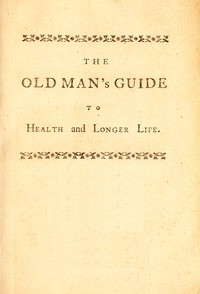
John Hill’s The Old Man’s Guide to Health and Longer Life (1771) opens with a striking claim: “Healthful old age is the most valuable period of human life.” The author, a physician and member of the Imperial Academy, addresses an audience he assumes to be men of sense, not medical professionals. The book’s subtitle promises rules for diet, exercise, and physic, and the early chapters deliver precisely that—but with an important caveat. Hill repeatedly insists that the old man may be “so far his own doctor” only for general distemperatures; once a disease takes hold, a physician must be called. This tension between empowerment and limitation runs through the entire work.
Defining the Aged Body Without a Fixed Age
Hill refuses to set a precise age at which old age begins. “Nature has herself left this undeterminable,” he writes, offering instead a memorable contrast: “I could at this hour point out a very young man of eighty-seven: and the purlieus of Covent-Garden abound with very old men at seven-and-twenty.” This rhetorical move allows him to speak to a broad readership while grounding his advice in individual constitution rather than calendar years. He eventually settles on “about fifty-eight” as a general starting point, but the flexibility is deliberate. The excerpt shows a writer who values observation over rigid classification, a stance that aligns with his later emphasis on self-knowledge and attention to one’s own symptoms.
Self-Diagnosis and Its Limits
Hill devotes chapters to helping the reader recognize common disorders—such as a “fulness of blood,” signaled by a full pulse, florid complexion, and difficult breathing. He prescribes gradual remedies: more motion and an abstemious diet, applied “slowly, determinately, and regularly.” Yet he is equally emphatic about the boundaries of lay medicine. In Chapter X he declares that “he is a very ill judge of the human frame, who will pretend to remedy its diseases without a knowledge both of its structure, and of the qualities of remedies.” The analogy is blunt: attempting self-treatment for serious illness is as absurd as learning watchmaking from a book. This dual message—trust your feelings, but know when to stop—gives the guide a practical, if cautious, tone.
The Role of Ease and Cheerfulness
Beyond diet and exercise, Hill identifies two additional preservatives for the aged: “Ease, and Cheerfulness.” He presents them as both the offspring of health and the means to continue it. This is not mere moralizing; it reflects a physiological theory in which mental state directly affects bodily condition. “The origin of his disorders is often very distant from their apparent effects,” Hill warns, urging the reader to keep the mind at peace. The advice is concrete: avoid sudden changes, live regularly, and attend to small discomforts before they grow. The closing of Chapter I reinforces this: “There is no pain in living regularly in old age; and the consequence of it is certain; a longer life, and every day of it more agreeable.”
Readers should approach this guide as a period document that reveals eighteenth-century attitudes toward aging, self-care, and medical authority. Hill’s voice is confident but circumscribed; he offers rules but also warns against overreach. The excerpts show a work that is less a complete home-doctor manual than a persuasive essay on moderation, grounded in the belief that the old man can—and should—take charge of his own health, up to a point.
There’s something touching in how Hill trusts his readers with so much, yet draws a line at the physician’s door. That same respectful caution surfaces in other old guides, where bodily wisdom feels both offered and withheld, as in Woman Her Sex and Love Life — Reading Notes. I keep thinking how much quiet faith these writers had in us, even as they guarded their limits.