About 330 minutes
American Red Cross Text-Book on Home Hygiene and Care of the Sick — Text and Context
Medicine
75,773 recorded words. 13 minutes difference from this book's estimate.
View Gutenberg source #32250
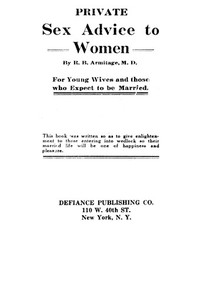
Before opening Private Sex Advice to Women: For Young Wives and those who Expect to be Married — Reading Notes, the edition data offers a quick orientation: 72,901 words, 5 hr 17 min estimated reading time, and 7 detected text sections.
The text analysis averages about 27.5 words per sentence, while the detected sections provide another way to judge how the source is divided.
Project Gutenberg metadata also associates the work with “Women -- Health and hygiene,” connecting these edition facts with the source record’s subject description.
Explore this collection
These alternatives are selected using recorded categories and estimated reading time.
About 330 minutes
Medicine
75,773 recorded words. 13 minutes difference from this book's estimate.
View Gutenberg source #32250About 348 minutes
Medicine
79,891 recorded words. 31 minutes difference from this book's estimate.
View Gutenberg source #31338About 352 minutes
Medicine
80,958 recorded words. 35 minutes difference from this book's estimate.
View Gutenberg source #19261Search stored excerpts and compare books → Choose by your preferences →
Choices use stored catalog measurements. Estimates vary with reading speed. A shared category is a catalog label, not a claim that two books have the same argument or literary quality.
Search reads excerpt text stored with this catalog and links to its associated Gutenberg record. The connection is stored in the site database; this tool does not recheck that every excerpt is word-for-word identical to that external record. Excerpt search does not cover every chapter and does not verify historical publication dates.
Catalog snapshot checked: 2026-09-25. Coverage: 93 public books, 93 available source excerpts.
Read the complete public-domain text at its original source.
Read on Project GutenbergDr. R. B. Armitage opens his 1917 marriage manual with a sharp critique of what he calls "the conventional taboo against Sex Knowledge," inherited from the Middle Ages and sustained by "Prurient Prudery." The book's title—Private Sex Advice to Women—signals its intended audience, but the opening lesson quickly broadens the target: ignorance of sex science, Armitage insists, is "a frequent cause of immorality" and "the real reason of marital inharmony and unhappiness." This blend of moral alarm and clinical instruction sets the tone for a work that moves between detailed anatomical descriptions, practical pregnancy advice, and speculative passages on sex determination.
Armitage's narrative voice oscillates between detached scientific explanation and urgent moralizing. In the foreword, he warns that women are "handicapped" by a lack of sane information, yet he also insists that their sex-life is "fuller and more complex" than men's. This dual posture—sympathetic yet paternalistic—shapes the book's rhetorical strategy. When describing the female reproductive organs, he promises "plain facts cleanly stated in simple terms," and the anatomy lesson that follows is indeed direct, using terms like vagina, uterus, and ovaries without euphemism. But the same lesson also includes a list of uterine displacements—prolapsus, anteversion, retroversion—that reads like a diagnostic checklist, hinting at the author's clinical background. The pacing shifts abruptly between these technical passages and broader cultural commentary, as when he blames "the Reign of Prurient Prudery" for perpetuating ignorance. This alternation keeps the reader off balance: one paragraph offers a dry description of the Fallopian tubes, the next a jeremiad against Victorian silence.
The gestation lesson is structured as a month-by-month account of fetal development, from the fertilized ovum to the "Table of the Development of the Unborn Child." Armitage uses terms like embryo, fetus, yolk-sack, allantois, placenta, and umbilical cord, explaining each in turn. The prose here is methodical, almost like a textbook, but it occasionally slips into a more narrative mode: he describes how "Nature builds up the child from the simple cell" and traces the journey of the ovum from ovary to womb. This section also includes practical advice—how to calculate the date of delivery—and a list of "Physical Signs of Pregnancy" and "Disorders of Pregnancy." The tone is reassuringly authoritative, though the reliance on nineteenth-century terminology ("umbillical cord" with two l's) dates the text. Readers expecting modern obstetrics will find the framework familiar but the details archaic, such as the emphasis on "Osmosis" as the mechanism of nutrient exchange.
One of the most striking passages in the excerpts concerns the possibility of influencing the sex of offspring. Armitage reviews a theory that a physiological condition leading to sugar excretion might inhibit male-determining ova, and he notes that some practitioners recommended diabetes-like treatment to produce boys. He immediately cautions that this method "cannot be held to have been established on a scientific basis." He then quotes the biologist Doncaster at length, who argues that sex may be determined solely by the spermatozoon, but also acknowledges evidence that the ovum plays a role. Doncaster's conclusion—that "the control of sex in man" is "not entirely impossible of realization"—is presented without strong endorsement. Another unnamed writer is cited to suggest that the early embryo is sexually indifferent and can be influenced by external conditions. Armitage does not resolve these conflicting views; instead, he lets the quotations stand, leaving the reader with a sense of scientific uncertainty that contrasts with the confident tone of earlier lessons.
Readers approaching this manual should be prepared for a text that moves unpredictably between anatomical precision, moral exhortation, and speculative biology. Armitage's willingness to quote conflicting authorities on sex determination, without settling the debate, suggests a writer more interested in surveying current knowledge than in delivering a single doctrine. The book's value today lies less in its medical accuracy—much of which is outdated—than in its documentation of early twentieth-century attitudes toward marriage, female physiology, and the limits of scientific certainty.
That 1917 manual has a strange tenderness—its stiff warnings against prudery feel like someone holding your hand too tightly. It made me think of Zoonomia; Or, the Laws of Organic Life, Vol. II — Context and Discussion, another voice from that older world, trying to make sense of bodies with such earnest care. Both leave a quiet ache, like remembering a good friend’s old letters.
Capture what you thought, learned, and would like to remember.