About 462 minutes
Epidemics Resulting from Wars — Background and Themes
Medicine
106,239 recorded words. 5 minutes difference from this book's estimate.
View Gutenberg source #59822
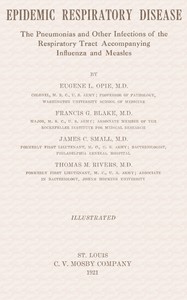
The source record for Epidemic Respiratory Disease The pneumonias and other infections of the repiratory tract accompanying influenza and measles — Story, Setting & Ideas measures this digital text at 107,237 words, 7 hr 47 min estimated reading time, and 25 detected text sections.
The text analysis averages about 16.2 words per sentence, while the detected sections provide another way to judge how the source is divided.
Project Gutenberg metadata also associates the work with “Measles,” connecting these edition facts with the source record’s subject description.
Explore this collection
These alternatives are selected using recorded categories and estimated reading time.
About 462 minutes
Medicine
106,239 recorded words. 5 minutes difference from this book's estimate.
View Gutenberg source #59822About 453 minutes
Medicine
104,011 recorded words. 14 minutes difference from this book's estimate.
View Gutenberg source #53007About 482 minutes
Medicine
110,632 recorded words. 15 minutes difference from this book's estimate.
View Gutenberg source #24440Search stored excerpts and compare books → Choose by your preferences →
Choices use stored catalog measurements. Estimates vary with reading speed. A shared category is a catalog label, not a claim that two books have the same argument or literary quality.
Search reads excerpt text stored with this catalog and links to its associated Gutenberg record. The connection is stored in the site database; this tool does not recheck that every excerpt is word-for-word identical to that external record. Excerpt search does not cover every chapter and does not verify historical publication dates.
Catalog snapshot checked: 2026-09-25. Coverage: 93 public books, 93 available source excerpts.
Read the complete public-domain text at its original source.
Read on Project GutenbergThe work opens with a striking shift in scale: a single statistic—that pneumonia and measles accounted for 16.8 percent of army mortality in 1916—is immediately contrasted with the nearly 62 percent figure for 1917. This abrupt numerical jump establishes a tone of urgent, data-driven inquiry. The prose is clinical and impersonal, favoring passive constructions and precise quantification: “there were extensive outbreaks of unusually severe pneumonia.” Yet the voice is not entirely detached; the authors occasionally acknowledge cooperation with named officers, injecting a brief human element into the otherwise methodical exposition.
The narrative voice maintains a steady, objective register when describing epidemiological patterns, but the pace changes markedly when the text moves from broad statistics to specific autopsy findings. In the introduction, sentences are long and packed with percentages and bacterial classifications, as in the discussion of pneumococcus types. Later, in the autopsy reports, the prose becomes more compressed and visually concrete: “the lung is red and laxly consolidated,” “the interlobular septa are marked by conspicuous yellowish gray lines.” The shift from population-level data to individual case histories (e.g., Autopsy 474) introduces a slower, more granular rhythm, with measurements in grams and cubic centimeters anchoring the description in tangible detail.
Throughout the excerpts, the authors rely heavily on passive constructions—“was studied,” “has been found,” “is favored by”—which reinforce an impersonal, authoritative tone. This choice aligns with the work’s scientific purpose but also creates a uniform pacing that can feel relentless. However, the density of specialized terms (e.g., “endophlebitis,” “interstitial suppurative pneumonia”) introduces a cognitive slowing, as readers must parse each term. The text does not define these terms in the excerpts, assuming a medically literate audience. This technical language, combined with the passive voice, produces a steady, deliberate cadence that mirrors the methodical nature of pathological investigation.
The excerpts reveal a deliberate variation in sentence length that modulates the reading pace. The introduction uses long, multi-clause sentences to convey complex relationships: “Pneumonia which occurred at Camp Funston during August was almost wholly limited to recently recruited colored troops from southern states (Louisiana, Mississippi).” In contrast, the autopsy sections employ shorter, more direct statements: “The right pleural cavity contains 85 c.c. of thick purulent fluid.” This alternation creates a rhythm where dense analytical passages are punctuated by stark, almost telegraphic observations. The effect is a controlled ebb and flow that guides the reader through layers of evidence without overwhelming them.
Readers approaching this work should attend to how the authors balance epidemiological overview with pathological specificity. The shifts in pace—from broad statistical claims to minute anatomical descriptions—are not arbitrary but reflect a layered argument about the etiology of wartime pneumonia. Noting these changes in narrative velocity can help one follow the progression from population-level patterns to the cellular and vascular changes that underpin the disease.
Sometimes, leafing through Opie’s careful tally of lungs and fevers, I feel a quiet gratitude for the dead who gave their bodies to that knowledge—a gratitude that runs, strangely, to that other old volume, Use of the Dead to the Living — Text and Context. One documents their sacrifice; the other asks why we owe them this tenderness at all.
Save your reaction, strongest insight, and memorable passage.