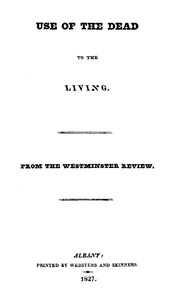
Southwood Smith opens his 1827 essay not with a dry policy argument but with a stark appeal to self-interest: 'Every one desires to live as long as he can.' He immediately ties the reader's own health to the need for anatomical dissection, framing ignorant physicians as 'more deadly enemies than the plague.' This rhetorical strategy—grounding a legislative plea in personal vulnerability—sets the tone for a work that moves between logical persuasion and emotional confrontation.
From Personal Stake to Public Duty
The essay's opening paragraphs build a chain of reasoning that links individual survival to the collective need for skilled surgeons. Smith asserts that 'life and health must be secured before any possible result of any possible circumstance can be of consequence.' He then pivots to the social cost of ignorance: unqualified practitioners cause 'constant, silent, secret' harm. This movement from the personal to the communal is a structural pattern throughout the text. Smith repeatedly returns to the idea that the living have a claim on the dead—not as a cold legal principle, but as an extension of the same instinct that makes us value life. He does not dismiss the emotional attachment to corpses; instead, he acknowledges it fully before arguing that 'the promotion of the happiness of the living is a duty from which we can never be exonerated.'
The Anatomy of Emotional Resistance
Smith devotes considerable space to dissecting the very feelings that oppose dissection. He describes the survivor's attachment to the corpse in vivid, almost tender language: 'here are still the features of my friend: this is his form, and the very particles of matter which compose this dull mass, a few hours ago were a real part of him.' He traces this reverence across cultures, noting that 'the customs of all nations, savage as well as civilized' show a spontaneous veneration for the dead. Yet he insists that these natural emotions must be 'controlled' when they conflict with a greater good. The essay thus performs a kind of emotional anatomy—laying out the structure of grief and awe, then arguing that reason must guide, not eradicate, them. This section reveals Smith's method: he does not mock sentiment but treats it as a real force that policy must acknowledge and redirect.
Historical Prejudice as a Cautionary Tale
Smith turns to history to show that the horror of dissection is neither universal nor immutable. He notes that 'in ancient times the voice of reason could not be heard' due to superstition and custom. The Jewish tenet of pollution, Egyptian taboos, and even Greek reluctance are cited as obstacles that once seemed insurmountable. The first recorded dissection, by Democritus of Abdera, is presented as a rare exception. The Romans, Smith observes, 'contributed nothing to the progress of the art.' This historical survey serves a dual purpose: it normalizes the current prejudice by showing it as one more stage in a long struggle, and it implies that progress is possible. The pattern of movement here is from present conflict to past precedent, suggesting that what seems fixed can change. Smith does not claim that history guarantees reform, but he uses it to loosen the grip of custom on the reader's imagination.
The Rhetoric of Contrast and Repetition
Smith's prose relies on sharp contrasts and recurring images to drive his argument. He juxtaposes the 'open and alarming notice' of plague with the 'constant, silent, secret' harm of bad doctors. He sets the 'noblest and sweetest sympathies' of veneration against the 'base and malignant purposes' of superstition. The body itself appears in two opposing lights: as a beloved form that 'cannot be separated' from the person, and as a 'senseless mass of matter' that must yield to higher needs. This binary structure forces the reader to weigh competing claims. Smith also repeats key phrases—'every one desires to live,' 'the promotion of the happiness of the living'—to anchor his argument. The movement between abstract principle and concrete image (the 'heap of mould,' the 'rosy hue' of the corpse) keeps the discussion grounded in felt experience, even as it pushes toward legislative action.
Smith's essay is best read as a piece of persuasive rhetoric that anticipates and neutralizes objections. Pay attention to how he handles the emotional core of the issue: he does not dismiss grief but argues that it must be weighed against the preventable suffering of the living. The historical examples are not mere decoration; they serve to show that current taboos are neither natural nor permanent. Readers interested in the intersection of medicine, law, and public sentiment will find a model of reasoned advocacy that remains relevant to debates about bodily autonomy and the common good.
The rain tapped against the window as I finished Southwood Smith's argument about prioritizing the living, and I sat with that strange, lingering thought—how the body keeps its own history. That quiet unease led me, almost by accident, to Shell shock and its lessons — Key Ideas to Explore, where the same rational pull toward the unseen wound felt strangely familiar. One book simply opened onto the next.