
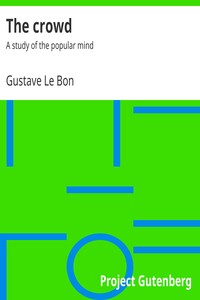
The crowd : A study of the popular mind by Gustave Le Bon
First off, this isn't a novel with a plot. Think of it more as an investigation. Gustave Le Bon, a French social psychologist, published this in 1895, a time of huge political upheaval. He wanted to understand the powerful, and often dangerous, force of the crowd.
The Story
Le Bon's 'story' is his argument. He observes that an individual in a crowd undergoes a psychological transformation. Your sense of personal responsibility melts away. You become more receptive to images and simple, repeated ideas rather than complex logic. The crowd, he says, is impulsive, irritable, and credulous – it craves a strong leader who projects absolute certainty. He uses examples from the French Revolution and contemporary events to show how crowds can swing from savage destructiveness to heroic sacrifice, all while believing they're on a sacred mission. The core conflict is between the rational individual and the hypnotic, emotional pull of the group.
Why You Should Read It
Reading this today is a wild experience. You have to constantly remind yourself this was written before radio, TV, or the internet. Yet, so much of it feels eerily familiar. When Le Bon talks about crowds needing 'images' and simple slogans, I immediately think of social media memes and political talking points. His description of how a crowd's emotion spreads like a contagion explains viral online outrage perfectly. It's not a comfortable read – some of his views on race and gender are products of his time and are plainly wrong. But if you can look past that, the central insight about our vulnerability in groups is powerful. It made me more aware of my own reactions in any large gathering, from a concert to a public meeting.
Final Verdict
This book is a must-read foundation for anyone curious about psychology, politics, or marketing. It's perfect for history buffs who want to understand the 19th-century roots of mass society, or for anyone who scrolls through Twitter and wonders how groupthink happens. It's also great for book clubs because it will spark fierce debate. Don't read it as the final word on the subject, but as the provocative starting point for a conversation we're still having over 125 years later. Just be ready to argue with the author in the margins – I did on nearly every page.
This work has been identified as being free of known copyright restrictions. You do not need permission to reproduce this work.
David Jones
5 months agoThe digital formatting makes it very easy to navigate.
Jessica Anderson
1 month agoThe research depth is palpable from the very first chapter.
Robert Jackson
7 months agoThe methodology used in this work is academically sound.
James Martinez
9 months agoInitially, I was looking for a specific answer, but the level of detail in the second half of the book is truly impressive. A mandatory read for anyone in this industry.



Thomas Gonzalez
4 months agoIt effectively synthesizes complex ideas into a coherent whole.