About 173 minutes
A Southern Woman's Story — Reading Notes
Medicine
39,583 recorded words. 5 minutes difference from this book's estimate.
View Gutenberg source #63870
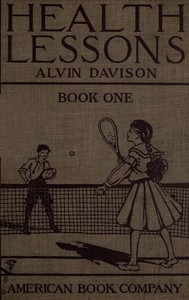
This digital edition of Health Lessons, Book 1 — A Closer Reading is described by source-level measurements including 40,828 words, 2 hr 58 min estimated reading time, and 7 detected text sections.
The text analysis averages about 14.7 words per sentence, while the detected sections provide another way to judge how the source is divided.
Project Gutenberg metadata also associates the work with “Physiology -- Juvenile literature,” connecting these edition facts with the source record’s subject description.
Explore this collection
These alternatives are selected using recorded categories and estimated reading time.
About 173 minutes
Medicine
39,583 recorded words. 5 minutes difference from this book's estimate.
View Gutenberg source #63870About 184 minutes
Medicine
42,196 recorded words. 6 minutes difference from this book's estimate.
View Gutenberg source #29612About 186 minutes
Medicine
42,604 recorded words. 8 minutes difference from this book's estimate.
View Gutenberg source #44325Search stored excerpts and compare books → Choose by your preferences →
Choices use stored catalog measurements. Estimates vary with reading speed. A shared category is a catalog label, not a claim that two books have the same argument or literary quality.
Search reads excerpt text stored with this catalog and links to its associated Gutenberg record. The connection is stored in the site database; this tool does not recheck that every excerpt is word-for-word identical to that external record. Excerpt search does not cover every chapter and does not verify historical publication dates.
Catalog snapshot checked: 2026-09-25. Coverage: 93 public books, 93 available source excerpts.
Read the complete public-domain text at its original source.
Read on Project GutenbergAlvin Davison opens Health Lessons, Book 1 with a stark statistic: “Scarcely one half of the children of our country continue in school much beyond the fifth grade.” This framing shapes the entire book as a concentrated effort to deliver life-saving health knowledge before many students leave formal education. Davison cites contemporary public health authorities and argues that “the highest patriotism is therefore the conservation of health,” linking personal habits to national welfare. The preface sets a tone of urgent practicality, aiming to replace ignorance with actionable facts.
Throughout the excerpts, fresh air is personified as “the good angel of health.” Davison repeatedly returns to ventilation with specific, measurable instructions. He advises opening windows “a foot at both the bottom and the top” in cold weather and doubling the opening in moderate weather. The text includes a diagram (Fig. 65) showing how bedroom windows should be positioned. Davison warns against drafts but insists on air movement, recommending a board or curtain to deflect incoming air upward. The language is direct and prescriptive: “Do not sit in a draft.” These details transform an abstract concept into a concrete, repeatable routine.
Davison addresses tuberculosis head-on, stating that “four hundred people die of tuberculosis in our country every day.” He contrasts past fatalism with current hope: “Now three fourths of those in the first stages of the disease get well.” The cure, he emphasizes, is not medicine but “fresh air, good food, and rest.” He illustrates with a personal anecdote about a family where three children died of tuberculosis and a fourth was saved by sleeping with windows open. The text also invokes historical evidence: “Many years ago when the Indians lived in tents… none of them had this dirty air disease.” Such comparisons make the argument vivid and memorable.
Davison explains that quiet breathing uses less than a pint of air, while the lungs hold over three quarts. He warns that “the air sacs at the top and in the bottom part of the lungs are seldom filled completely” and that disease begins there. His remedy is explicit: “Several minutes should be spent two or three times each day in exercising the lungs.” He instructs readers to “hold the head up and the shoulders back” and to “sit straight.” The text includes a contrasting illustration (Fig. 67) of an “unhealthful position which squeezes the lungs.” This section blends anatomy with direct behavioral commands, typical of the book’s instructional style.
In a brief but striking passage, Davison links tobacco smoke to poison by describing greenhouse owners who burn tobacco stems to kill insects. He writes, “The smoke rises and fills the whole house.” The implication is clear: if tobacco smoke can suffocate insects, it harms human lungs as well. This example is characteristic of Davison’s method—using a familiar, observable phenomenon to teach a health lesson. The passage is short, but it reinforces the book’s recurring theme that pure air is essential and that contaminants, whether from closed windows or tobacco, are measurable threats.
Davison’s book is best read as a series of concrete instructions rather than a continuous narrative. Each chapter builds on a single idea—ventilation, lung exercise, disease prevention—and supports it with specific numbers, personal stories, and visual aids. Readers will benefit from pausing after each section to consider how the advice applies to their own habits. The text rewards attention to its diagrams and repeated emphasis on measurable actions, from window openings to breathing exercises.
I remember the old primer’s insistence on cracking a window, that simple faith in air. It made me think of my grandmother’s whispered worries about “good stock.” We inherit habits and fears so quietly. Searchlights on Health: The Science of Eugenics — Text and Context later made that same childhood certainty feel colder, a draft I hadn’t noticed before.
Create a short personal record of your experience with this book.