About 60 minutes
Workhouse Nursing: The story of a successful experiment — A Reader’s Guide
Medicine
13,582 recorded words. 6 minutes difference from this book's estimate.
View Gutenberg source #50432
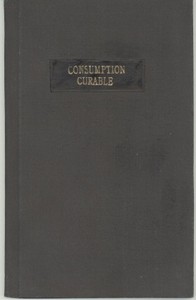
Before opening Consumption Curable: Observations on the Treatment of Pulmonary Diseases — Story, Setting & Ideas, the edition data offers a quick orientation: 15,173 words, 1 hr 6 min estimated reading time, and 2 detected text sections.
The text analysis averages about 30.2 words per sentence, while the detected sections provide another way to judge how the source is divided.
Project Gutenberg metadata also associates the work with “Respiratory organs -- Diseases -- Treatment,” connecting these edition facts with the source record’s subject description.
Explore this collection
These alternatives are selected using recorded categories and estimated reading time.
About 60 minutes
Medicine
13,582 recorded words. 6 minutes difference from this book's estimate.
View Gutenberg source #50432About 58 minutes
Medicine
13,220 recorded words. 8 minutes difference from this book's estimate.
View Gutenberg source #49319About 58 minutes
Medicine
13,172 recorded words. 8 minutes difference from this book's estimate.
View Gutenberg source #53877Search stored excerpts and compare books → Choose by your preferences →
Choices use stored catalog measurements. Estimates vary with reading speed. A shared category is a catalog label, not a claim that two books have the same argument or literary quality.
Search reads excerpt text stored with this catalog and links to its associated Gutenberg record. The connection is stored in the site database; this tool does not recheck that every excerpt is word-for-word identical to that external record. Excerpt search does not cover every chapter and does not verify historical publication dates.
Catalog snapshot checked: 2026-09-25. Coverage: 93 public books, 93 available source excerpts.
Read the complete public-domain text at its original source.
Read on Project GutenbergHenry Congreve's Consumption Curable (1839) opens with a polemic against the medical establishment, lamenting that the "medicinal properties concentrated in the plants which adorn the vegetable kingdom" have been neglected in favor of "compounds, emanating from the laboratory." The author positions himself as a restorer of an "obsolete" ancient mode of cure, specifically for pulmonary complaints. The excerpts reveal a work that is part botanical treatise, part dietary manual, and part advertisement for Congreve's own "Balsam," which he claims imparts "a healing quality" to the lungs after deterging mucus. The catalog subjects—tuberculosis, influenza, respiratory diseases—are invoked broadly, but the text focuses on Congreve's proprietary method rather than systematic disease classification.
Congreve repeatedly contrasts the "simples" of ancient authors with the "complicated and obscure" compounds of his day. He asserts that disorders now "alarmingly prevalent" were once "scarcely known" because practitioners relied on remedies "sent by the immediate hand of Providence." The excerpts do not name specific plants beyond marshmallow root, but the rhetoric emphasizes accessibility: remedies are "most abundant and common," found in "the soil of Nature's platform." This appeal to natural simplicity serves both as a medical argument and a marketing strategy, positioning Congreve's balsam as a rediscovered wisdom rather than a novel invention.
A substantial portion of the excerpts addresses diet, with Congreve citing Hippocrates on the dangers of "slender and insufficient diet" in lingering diseases. He advocates for "invigorating" rather than stimulating food, giving "decided preference" to animal diet over vegetable for most patients, as it "enriches the vital fluid—the blood." The author stresses proper mastication to incorporate saliva, and warns against overloading the stomach. This focus on digestion and nutrition suggests that Congreve viewed pulmonary consumption as a systemic disorder requiring constitutional strengthening, not merely local treatment of the lungs.
Congreve recommends "frequent changes of air and scene," particularly sea air, which he claims is "of all others, the purest" and stimulates deeper inspiration, enlarging the chest cavity. However, he notes exceptions: some consumptive patients "never agree" with sea air, requiring country air instead. These environmental measures are framed as "auxiliaries" to the regular use of his Balsam, which he insists "will supersede" other remedies. The excerpts thus present a layered regimen—diet, air, exercise, and the proprietary balsam—but the balsam remains the non-negotiable core, reflecting the work's dual identity as medical guide and product promotion.
Readers should note that the excerpts represent only the opening and a later portion of the text; the full work may contain more detailed case histories or specific botanical recipes. Congreve's repeated claims of a "twenty-seventh edition" and patronage by "Nobility and Medical Men" suggest a self-published or proprietary work aimed at a lay audience seeking alternatives to orthodox medicine. The catalog subjects—tuberculosis, influenza, respiratory diseases—are umbrella terms; the text itself is less a clinical description than a persuasive argument for a particular therapeutic approach.
This old treatise reminded me of my grandmother’s medicine chest, where camphor and honey sat beside tinctures. Reading about Henry Congreve’s stubborn faith in his balsam, I felt that same earnest, almost tender conviction I once found in A Treatise on Anatomy, Physiology, and Hygiene (Revised Edition) — Background and Themes. Both books whisper a quiet belief that the body, if only listened to, might heal itself.
Save your reaction, strongest insight, and memorable passage.