
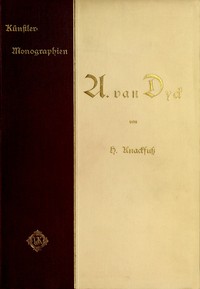
A. van Dyck by H. Knackfuss
Let's be honest, old art books can sometimes feel like homework. But Hermann Knackfuss's volume on Anthony van Dyck, first published in 1899, is a delightful exception. It's a portal to the Baroque era, written with a scholar's knowledge but a storyteller's heart.
The Story
This isn't a novel with a plot, but the arc of Van Dyck's life is a compelling story in itself. Knackfuss takes us from Van Dyck's early days as a brilliant student of Rubens in Antwerp to his triumphant career in Italy and, finally, to his reign as the favored court painter to King Charles I of England. We see him navigate the dangerous politics of royal courts, invent a whole new style of aristocratic portraiture that emphasized elegance and grace over raw power, and build a thriving workshop. The 'conflict' here is subtle but fascinating: it's the tension between the artist's own vision and the demands of his wealthy, powerful patrons. How much of Van Dyck's work is true artistry, and how much is brilliant flattery?
Why You Should Read It
What makes this book special is how it connects the art to the artist's world. Knackfuss doesn't just describe paintings; he explains why they looked the way they did. You learn how Van Dyck's portraits were tools of politics, designed to project an image of divine-right majesty for Charles I at a time when that idea was starting to crack. The writing brings the 1600s to life—the lavish clothes, the intricate wigs, the opulent palaces. You get a real sense of Van Dyck not as a dusty old master, but as a savvy, ambitious, and immensely talented businessman-artist trying to make his mark.
Final Verdict
This is a perfect pick for anyone who enjoys historical biographies or has ever visited a museum and wanted to know more about the faces staring back from the canvases. It's for the reader who likes their history served with personality, not just dates and facts. While it's an older text (and you can find it for free online through projects like Project Gutenberg), its insights remain fresh. If you're a fan of shows like The Great or Versailles that explore the drama behind the throne, you'll find the real-life backdrop here just as engrossing.
This content is free to share and distribute. It is available for public use and education.
Deborah Torres
1 year agoHaving read this twice, the clarity of the writing makes this accessible. Definitely a 5-star read.
Sandra Davis
1 year agoThe formatting on this digital edition is flawless.



Steven White
1 year agoTo be perfectly clear, it creates a vivid world that you simply do not want to leave. I will read more from this author.